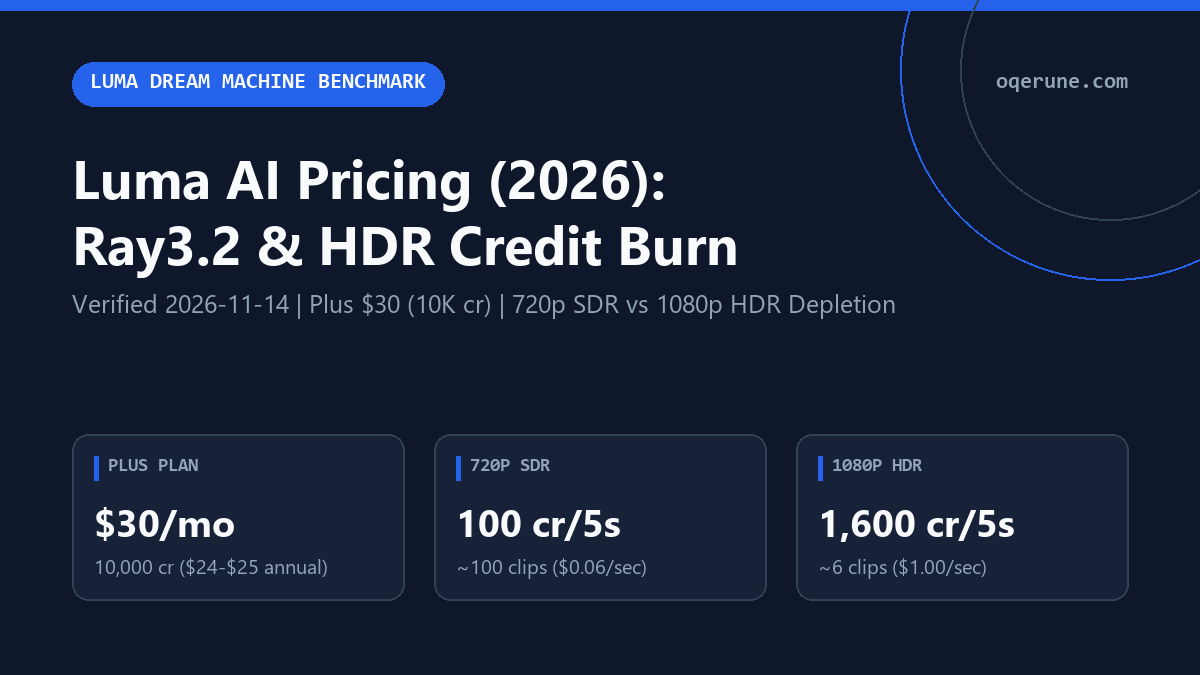
Luma AI
AI Video Verified- Entry paid tier Entry annual tier Self-serve API rate
- $30/mo $25/mo $0.0032/cr
- Plus: 10,000 cr, commercial Billed $300/yr (10,000 cr/mo) Self-serve API ($0.20 / 5s Ray 2)
- Mid production tier Mid annual tier Ultra 150K tier
- $90/mo $75/mo $250/mo yr
- Pro: 40,000 cr ($2.25/1K cr) Billed $900/yr ($1.88/1K cr) Ultra 150K cr ($300 mo, $1.67/1K)
- Real unit cost
- 16x swing
- 720p draft vs 1080p HDR burn
Luma AI prices Dream Machine around large monthly credit pools starting at $30 per month on Plus, yet actual video yield swings by 16x depending on whether you render 720p drafts or 1080p HDR shots. Without understanding Ray3.2 resolution multipliers, a 10,000-credit monthly budget can vanish after just six short clips.
Every plan rate, resolution multiplier, video-to-video cost, and top-up rollover rule below was verified from Luma Labs Dream Machine documentation on 2026-11-14. Test your monthly clip volume side by side against Runway and Kling inside our AI cost calculator or compare full category prices in our AI video cost benchmark.
Luma Dream Machine plans and top-up packs
Luma offers three published self-serve subscriptions (Plus, Pro, and Ultra) alongside quote-based Team and Enterprise workspaces, all featuring commercial usage rights and watermark-free output. Annual billing cuts monthly prices by roughly 17% to 20%, and paid users can buy supplemental credit packs that stay valid for 12 months.
| Plan tier | Monthly price | Annual billing (equiv.) | Included monthly credits | Commercial rights and top-ups |
|---|---|---|---|---|
| Plus | $30/mo | $24 to $25/mo | 10,000 credits | Commercial license, no watermark, fast queue |
| Pro | $90/mo | $72 to $75/mo | 40,000 credits | Higher priority, ~$2.25 per 1,000 monthly credits |
| Ultra | $300/mo | $240 to $250/mo | 150,000 credits | Studio volume (~$2.00 per 1,000 monthly credits) |
| Team / Enterprise | Custom quote | Custom annual contract | 150,000+ shared pool | Admin controls, SSO, fine-tuning, no-train guarantee |
| Credit Top-Ups | $4/pack | API $0.0032/cr | 12-mo rollover packs | 1,200 cr/pack (~$0.20 / 5s Ray 2 API) | Developer API bills $0.0032 per credit with zero monthly expiry |
A limited Free evaluation queue exists for exploration, while legacy Lite ($9.99/mo) references remain in older support articles and are excluded from active main checkout tiers. Paid Luma workspaces also expose Ray3.2 alongside partner models like Uni-1.1, Seedance, Kling, Veo, and MiniMax inside Creative Agents.
Ray3.2 and HDR credit burn per 5-second clip
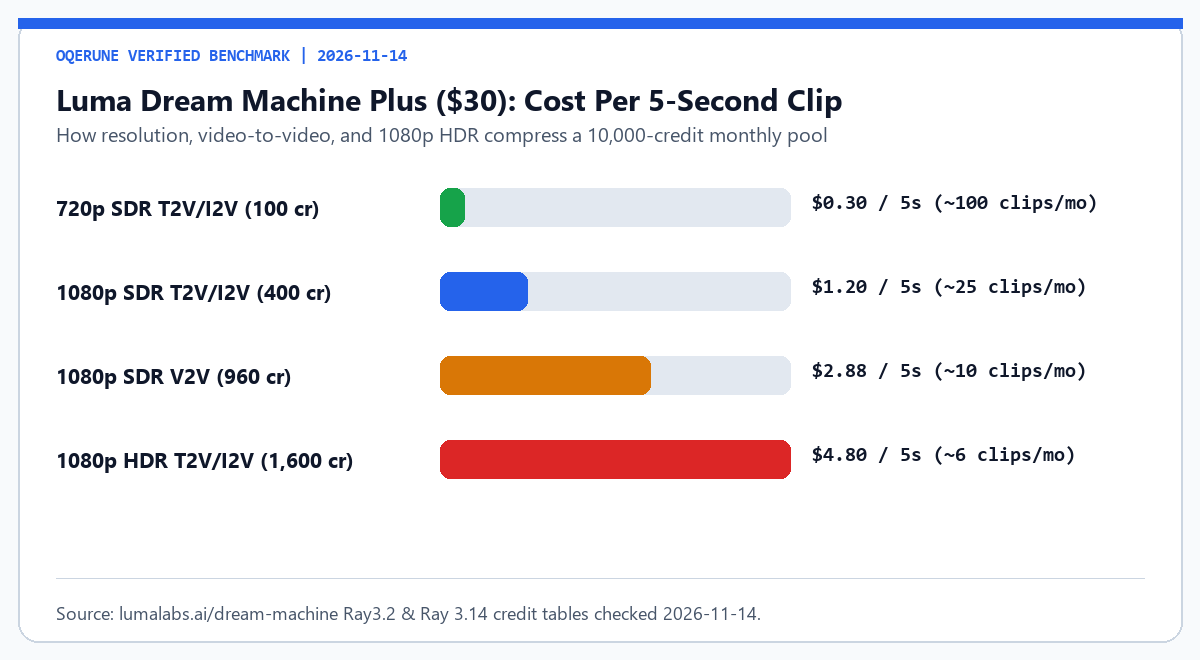
Because Plus credits average $0.003 each at the $30 monthly rate ($3.00 per 1,000 credits), switching from 720p SDR to 1080p HDR multiplies clip expense by 16x for identical 5-second duration.
| Render setting | Credits per 5s clip | Per-second credit burn | Normalized Plus ($30) cost | Monthly Plus 10,000-cr yield |
|---|---|---|---|---|
| 720p SDR T2V or I2V | 100 credits | 20 cr/sec | $0.30/clip ($0.06/sec) | ~100 clips (500s footage) |
| 1080p SDR T2V or I2V | 400 credits | 80 cr/sec | $1.20/clip ($0.24/sec) | ~25 clips (125s footage) |
| 1080p SDR Video-to-Video | 960 credits | 192 cr/sec | $2.88/clip ($0.58/sec) | ~10 clips (50s footage) |
| 1080p HDR T2V or I2V | 1,600 credits | 320 cr/sec | $4.80/clip ($0.96/sec) | ~6 clips (30s footage) |
Generating a 5-second clip without start or end keyframes adds 30 credits per render, whereas testing motion prompts with Ray2 Flash trims draft burn by up to 3x before locking final 1080p or HDR shots.
Monthly budget scenarios and top-up math
Reserve 1080p HDR and video-to-video passes for approved hero cuts rather than exploratory prompting. A single weekend of testing six 1080p HDR shots exhausts 9,600 credits, leaving virtually no balance for the rest of the month.
- Running motion blocking in 720p SDR at $0.30 per 5-second clip stretches a single $30 Plus subscription across roughly 100 iterations, or 80 drafts plus 5 final 1080p SDR masters.
- Teams facing spiky client deadlines benefit from Luma’s $4 top-up packs (1,200 credits) because purchased top-ups roll over for 12 months instead of resetting at month end.
- Reviewers who exhaust credits after two to five HDR clips usually compare poorly against Runway Gen-4.5, where Standard ($15/month) predicts clip count linearly at 12 credits per second.
Luma AI vs Kling 3.0, Runway Gen-4.5, and Higgsfield
Luma fits commercial motion designers who iterate at 720p ($0.06/sec) and selectively render approved shots in 1080p SDR or HDR, whereas competitors price raw B-roll differently.
- Kling AI lowers the commercial entry price to ~$8.80/month (~$0.53 to $0.67 per 5s 1080p silent clip), undercutting Luma’s $30 Plus minimum when you want low-volume native audio B-roll.
- Runway Gen-4.5 ($15/month Standard, $35/month Pro) guarantees predictable flat per-second credit math plus built-in 4K upscaling without HDR multiplier surprises.
- Higgsfield AI ($29/mo annual Plus) wraps Seedance 2.5 and multi-model camera workflows under timed Unlimited promo windows alongside Seedance 2.0 API options.
Frequently asked questions
What happens if a Luma Dream Machine video fails or misses the prompt?
Credits deducted for rendered prompts are normally non-refundable even when camera motion or anatomy misses intent, making 720p SDR or Ray2 Flash previews important before rendering 1080p HDR shots.
When do I get commercial usage rights on Luma AI?
Commercial rights and watermark removal unlock starting on the Plus ($30/month) plan and continue across Pro, Ultra, Team, and Enterprise tiers.
Why does 1080p HDR burn credits so much faster than 720p SDR?
A 5-second 720p SDR shot uses 100 credits, jumping 4x to 400 credits for 1080p SDR and 16x to 1,600 credits for 1080p HDR due to higher dynamic range and spatial rendering overhead.
Do Luma AI subscription credits roll over each month?
Monthly subscription pools reset at the end of your billing period, whereas $4 top-up packs (1,200 credits) roll over and remain usable for 12 months.
What is the difference between Fast priority and Free queues on Luma?
Plus, Pro, and Ultra subscriptions assign dedicated fast generation priority and commercial licensing, whereas free exploration queues wait behind paid workloads and lack commercial distribution rights.